ServicesStair Flooring
Stair Flooring in League City
A staircase takes more wear per square foot than any floor in your home. We fix what can be fixed, like a loose tread, a split nosing or a squeak, and when the stairs need new surfaces we install treads and risers that match the floors around them.
Stairs Are Built in Layers, So We Look at Each One
Every stair has a structure underneath and a finish on top. The stringers carry the load, the treads and risers close it in, and the nosing takes the hit from every foot that comes down. Most problems start at one of those joints: a tread that has worked loose from the stringer, a nosing that has cracked along its glue line, or carpet pad that has packed flat at the edge.
Our first question is whether the fault is in one part or across the whole run. A single loose or damaged tread can usually be re-secured or swapped out without touching the rest. If the treads are worn through, the stairs no longer match a new floor on the landing, or the old carpet is hiding particleboard steps, a full new surface is the better use of your money, and we will tell you why.
What Our Stair Work Covers
- Loose tread and squeak repair
- Squeaks come from a tread rubbing against the stringer or riser as it flexes. We re-fasten it with construction adhesive and screws driven into the framing, and add glue blocks underneath where we can reach them.
- Single tread and nosing replacement
- A cracked tread or broken nosing can be cut out and replaced on its own. We match the thickness and the nosing profile so the step height stays the same as its neighbors.
- Hardwood treads and risers
- Solid wood treads with a matching or painted riser, cut to fit each step. Old stairs are rarely perfectly square, so every tread is scribed to its own opening.
- Vinyl and laminate stair nosing
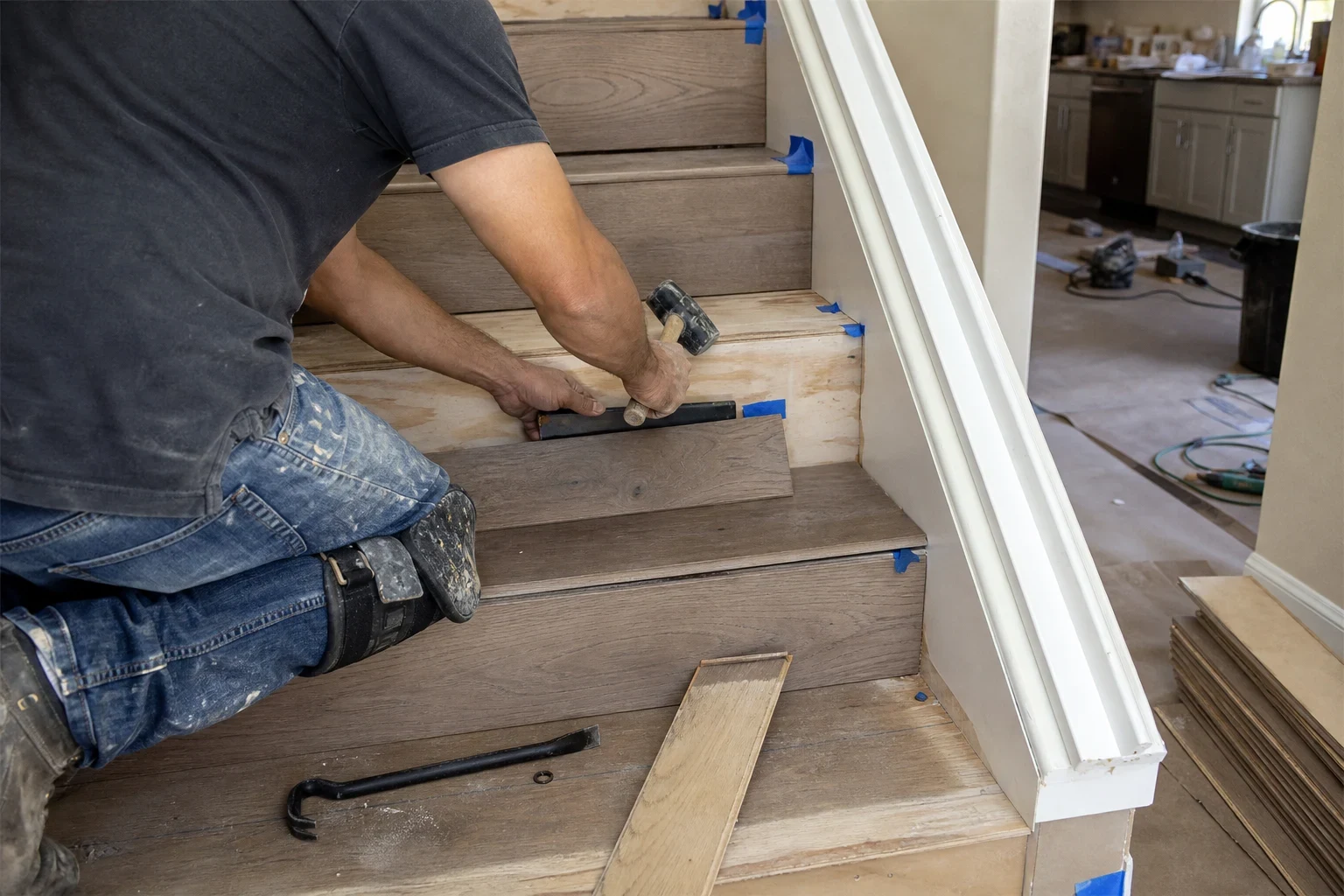
- When your Luxury Vinyl Plank or Laminate Flooring runs up the stairs, each step gets a plank on the tread, a riser piece and a stair nose molding glued and fastened to the edge. Floating floors cannot float on stairs, so every piece is glued down to the step beneath it.
- Carpet on stairs
- We install carpet as a waterfall over the nosing or wrapped tight around each step, with tack strip and pad sized for stairs. See our Carpet Installation page for the rest of the house.
Signs Your Stairs Need Attention
A squeak on the same step
A repeating squeak means a tread is moving against its framing. It is usually a fastening problem, not a reason to replace the stairs.
A tread that dips or rocks
Visible movement underfoot means the tread has separated from the stringer or the riser below it. That is a trip hazard and worth fixing before it splits.
Worn or rounded nosings
The nosing edge wears first. When the finish is gone and the wood has rounded over, footing gets less certain, and a new nosing or tread is the fix.
Carpet loose at the edge
Carpet that slides or bunches at the nosing usually has a worn pad or failed tack strip. Sometimes it can be re-stretched; if the backing has broken down it needs replacing.
Stairs that clash with new floors
If you are putting new flooring on the landing or downstairs, stairs left in old carpet or dated wood can look unfinished. Covering them at the same time keeps transitions clean.
How a Stair Job Runs
- 1
Phone call and look at the stairs
We start with a call about what is happening, then look at each step in person. We check for movement, test the nosings and, where carpet is down, lift a corner to see what the treads are made of.
- 2
Repair or resurface answer
You get a straight recommendation step by step. If two treads need re-securing and the rest are sound, that is what we quote.
- 3
Removal and prep
Old carpet, pad, tack strip and staples come out. We fix any loose treads, then trim back overhanging nosings if the new surface needs a flush edge.
- 4
Fitting each step
Treads and risers are measured and cut one at a time because stair openings vary by a quarter inch or more. Everything is glued and fastened, then nosing pieces go on last.
- 5
Cleanup and walk-through
We vacuum the dust and offcuts and walk the stairs with you. Adhesive needs time to cure, so we tell you when the stairs are ready for normal traffic.
What Moves the Price of Stair Work
Stairs are priced by the step and by the work each step needs, not by square footage. A straight run of solid steps costs less to cover than a winding stair with open sides. We put each part on a written estimate so you can see where the money goes.
- Number and shape of steps
- Winders, pie-shaped landings and bullnose starter steps each need custom cuts. Straight steps go faster.
- Open or closed stringers
- An open side shows the end of every tread and riser, which needs returned nosings or finished end caps. Closed stairs tucked between walls are simpler.
- What is under the old surface
- Particleboard or builder-grade pine under carpet often cannot be left exposed and must be capped or replaced. Solid treads in good shape can sometimes be covered directly.
- Material choice
- Solid hardwood treads, vinyl or laminate with stair nose, and carpet each carry different material and labor costs. Matching a specific floor elsewhere in your home can also narrow the options.
Stair Flooring Questions
Something not covered here? (346) 409-7643
Can you fix one squeaky step without redoing the whole staircase?
Yes, in most cases. A squeak is usually a tread moving against its stringer or riser, and we re-fasten it with adhesive and screws into the framing. If the carpet is down, we pull it back at that step and re-stretch it after.
Can my vinyl plank or laminate continue up the stairs?
It can. Each tread gets a plank glued in place with a matching stair nose molding on the edge, and the riser gets its own piece. Because these floors normally float, on stairs every piece is fully adhered so nothing shifts.
I pulled up a corner of the carpet and found particleboard. Can that be my finished stair?
Not as it is. Particleboard treads are meant to be covered, and they chip and swell if exposed. We can cap them with new hardwood or vinyl treads, or recarpet them, depending on the look you want.
Will new treads change the height of my steps?
Adding a cap tread raises each step by its thickness, including the top and bottom ones. Building codes limit how much step heights can vary, so we plan the layers to keep the top and bottom steps within range of the rest.
How long are the stairs out of use?
A repair to a few treads is usually walkable the same day. A full resurface takes longer, and the adhesive needs time to cure before heavy traffic. We tell you up front so you can plan around it.
Find Out What Your Stairs Really Need
Tell us which steps squeak, move or look worn. We will look at them and tell you whether a repair will hold or a new surface is the smarter call.