ServicesCarpet Installation
Carpet Installation in League City
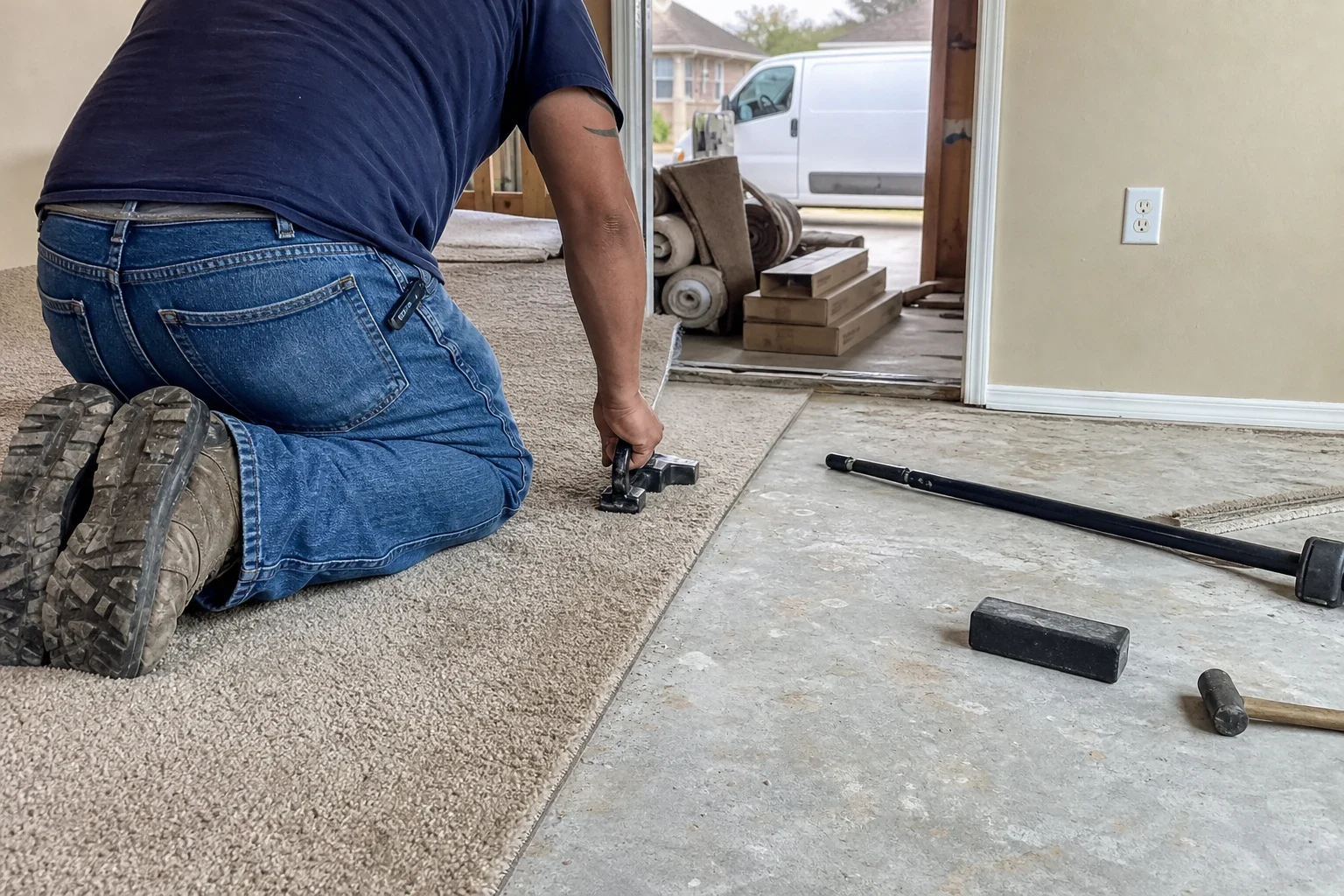
We install carpet and pad over a subfloor we have checked first, then power-stretch it so it stays flat for years. If your current carpet only has ripples or a loose seam, we will tell you whether a restretch or repair makes more sense than tearing it out.
New Carpet, or a Fix for the One You Have
Most carpet problems come from installation, not wear. A carpet that was stretched with a knee kicker alone, laid over the wrong pad or seamed without sealing the cut edges will ripple, gap and fray long before the fiber is worn out. When that is the cause and the face yarn still looks good, restretching or a seam repair is the honest answer, and we say so.
Replacement makes sense when the pile is matted flat in traffic lanes, the backing has started to separate, or pet urine has soaked through to the pad and slab. In those cases we pull everything up, fix what is underneath and install new carpet properly. Many homes here sit on concrete slabs, so we pay close attention to moisture and to how the tack strip is fastened.
What Our Carpet Installation Covers
- Removal of old carpet and pad
- We cut the old carpet into manageable rolls, pull the pad and staples, and haul it out of your home. Broken or rusted tack strip comes up with it.
- Slab and subfloor check
- We look for cracks, high spots, old adhesive and moisture before anything new goes down. Small cracks get patched and ridges get ground so they do not telegraph through the pile.
- Pad matched to the carpet
- Pad density and thickness change how carpet wears. Plush cut pile can take a thicker pad, while Berber and other loop styles need a thinner, firmer one so the backing does not flex and split. On slab we can use a pad with a moisture barrier film.
- Power stretching and tack strip
- We use a power stretcher that braces against the opposite wall, which sets the carpet much tighter than a knee kicker. New tack strip is fastened with concrete nails sized for the slab.
- Seams placed and sealed
- We plan the layout so seams run with the light and away from doorways where possible. Seams are joined with hot-melt tape, and the cut edges get seam sealer so the yarn does not unravel.
- Transitions and cleanup
- Where carpet meets tile, luxury vinyl plank or hardwood, we fit a transition that holds the edge down. We vacuum the new carpet and clear out the scraps before we leave.
Signs Your Carpet Needs Attention
Ripples and soft waves
Bubbles that cross a room usually mean the carpet was under-stretched or has relaxed in humid weather. This is often fixable with a restretch if the backing is sound.
Seams that gap or fray
An open seam is commonly a failed tape or an unsealed edge. A section can often be reseamed without redoing the whole room.
Matted traffic lanes
When the pile in hallways and in front of the sofa stays crushed after vacuuming, the fiber has lost its twist. Cleaning will not bring it back, and that points to new carpet.
Crunchy or crumbling backing
If the carpet feels stiff or sheds grit from the back, the latex holding the layers together has broken down. Delaminated carpet cannot be stretched again.
Odors that return after cleaning
Smells that come back point to contamination in the pad or on the slab. The fix is new pad, sealing the concrete, and usually new carpet.
How a Carpet Job Runs
- 1
Measure and look underneath
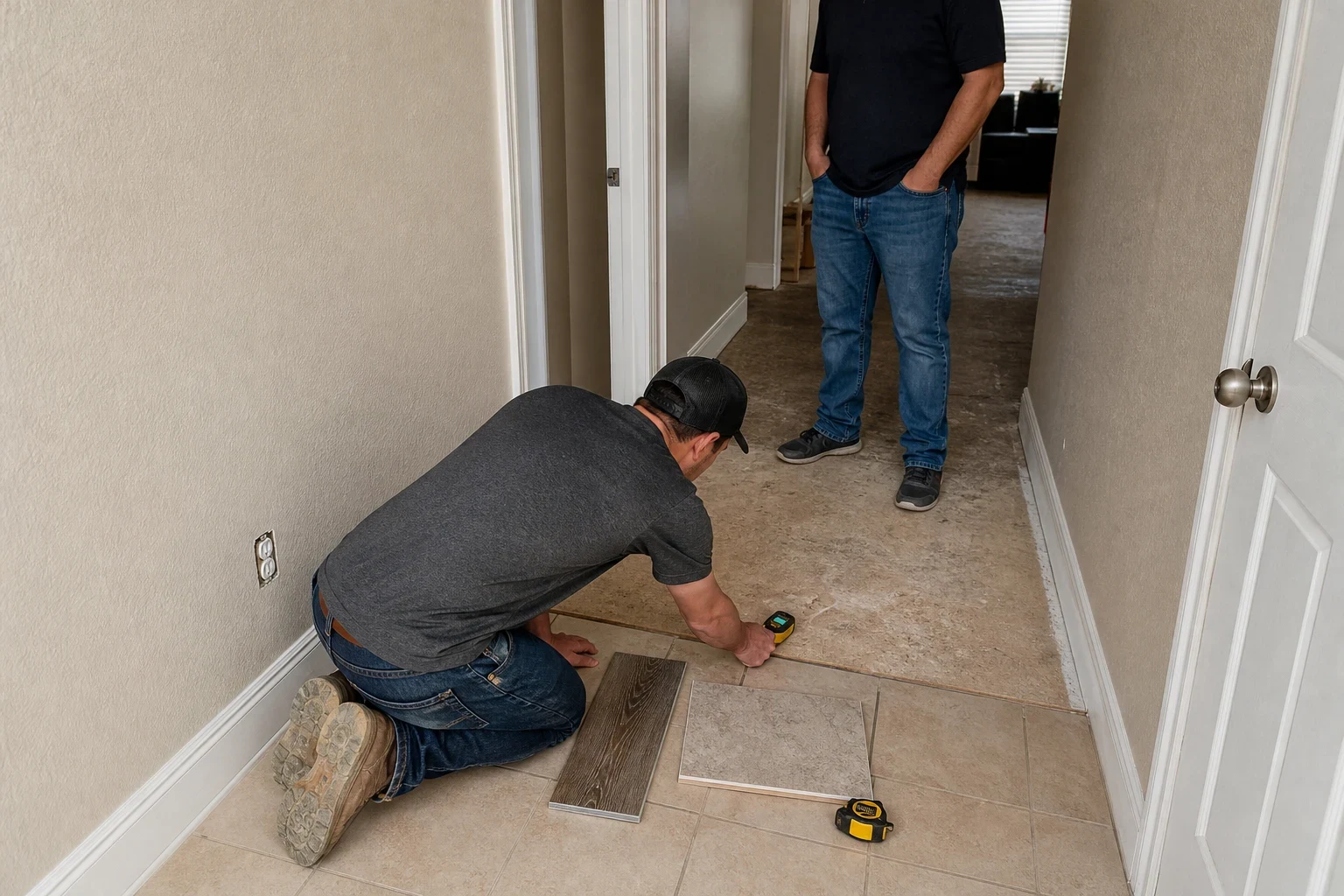
We measure each room, lift a corner where we can, and check the pad and slab. This is when we tell you whether restretching or repair will hold, or whether new carpet is the better spend.
- 2
Plan the layout
Carpet comes in rolls, often 12 feet wide, so we draw out where seams fall and how much material the job needs. You see the seam plan before anything is ordered.
- 3
Prep the room
On install day we move furniture as agreed, pull the old carpet and pad, and prepare the slab. Tack strip goes in about a finger-width from the baseboard.
- 4
Install, stretch and seam
Pad goes down with its seams offset from the carpet seams. We lay the carpet, join seams, and power-stretch it onto the tack strip before trimming and tucking the edges.
- 5
Walk-through
We put furniture back, vacuum, and walk the rooms with you. Doors that drag on the new, thicker floor are noted so they can be trimmed.
What Moves the Price of Carpet Installation
Your quote depends mostly on how much carpet the layout needs and what we find underneath. We break those pieces out in the estimate so you can see where the money goes. If a repair will solve the problem, we price that instead.
- Room shape and roll width
- Odd-shaped rooms and long hallways create more waste from a 12-foot roll than a simple rectangle, so material needed can exceed the floor area.
- Carpet fiber and pad
- Nylon, polyester, triexta and olefin wear and price differently. Pad density and any moisture barrier add to the total.
- Stairs
- Each step is cut, wrapped and stretched by hand, so stairs take far more labor than open floor. Our stair flooring page covers that work in detail.
- Slab prep and removal
- Patching cracks, grinding ridges, sealing pet stains and installing new tack strip all add time. So does hauling off old carpet and moving heavy furniture.
Carpet Installation Questions
Something not covered here? (346) 409-7643
Can you restretch my carpet instead of replacing it?
Often, yes. If the ripples come from a loose original stretch and the backing is still flexible, we can power-stretch it and trim the excess. If the backing is delaminating or the pile is worn flat, restretching will not last and we will tell you that up front.
How long does a typical carpet job take?
A few bedrooms and a hallway usually take one day. Add time for stairs, heavy slab prep or a whole floor of rooms. We walk you through the expected schedule when we measure.
What pad do you use on a concrete slab?
We pick the pad for the carpet style first, then consider the slab. A pad with a moisture barrier film helps keep slab moisture and spills from moving between the carpet and concrete. Loop carpet needs a firmer, thinner pad than plush cut pile.
Do I need to empty the rooms?
Clear out small items, closet floors and anything fragile. We can move most furniture as part of the job, and we will ask about pianos, safes and large electronics during the estimate.
Will my doors still close?
New carpet and pad can sit higher than what you have now, so some interior doors may rub. We check clearance at each door and point out any that will need trimming.
Is carpet a good choice for a room that gets wet?
Not for bathrooms, laundry rooms or entries that see a lot of water. For those spaces we usually suggest tile flooring or luxury vinyl plank, and carpet tile can work in a playroom where a stained square can be swapped out.
Find Out Whether Your Carpet Can Be Saved
Tell us what you are seeing, from ripples to worn traffic lanes. We will set a time to measure, check underneath and give you a straight repair-or-replace answer.