ServicesHardwood Flooring
Hardwood Flooring in League City, Fixed Where It Can Be
We install solid and engineered hardwood and fix the boards you already have. When a squeak, a cupped strip or a few water-stained planks can be saved, we tell you. When the moisture or subfloor underneath means new flooring is the better buy, we show you why.
How we decide between a fix and a new floor
Most hardwood problems start below the boards. Moisture moving up through a concrete slab, a loose fastener over a joist or a slow leak under a dishwasher shows up as cupping, squeaks or dark stains. If the cause is fixed and the damage is limited to a few rows, swapping out those boards is usually the sensible job.
A full new floor makes more sense when damage runs across a large area, when the product is discontinued and no close match exists, or when the slab is pushing so much moisture that any new boards would fail the same way. We take meter readings and photos, then explain which situation you are in so you know where you stand ahead of buying any materials.
We start every hardwood call by asking whether a repair will hold, and we will not patch a floor that is going to keep failing.
What our hardwood work covers
- Moisture testing first
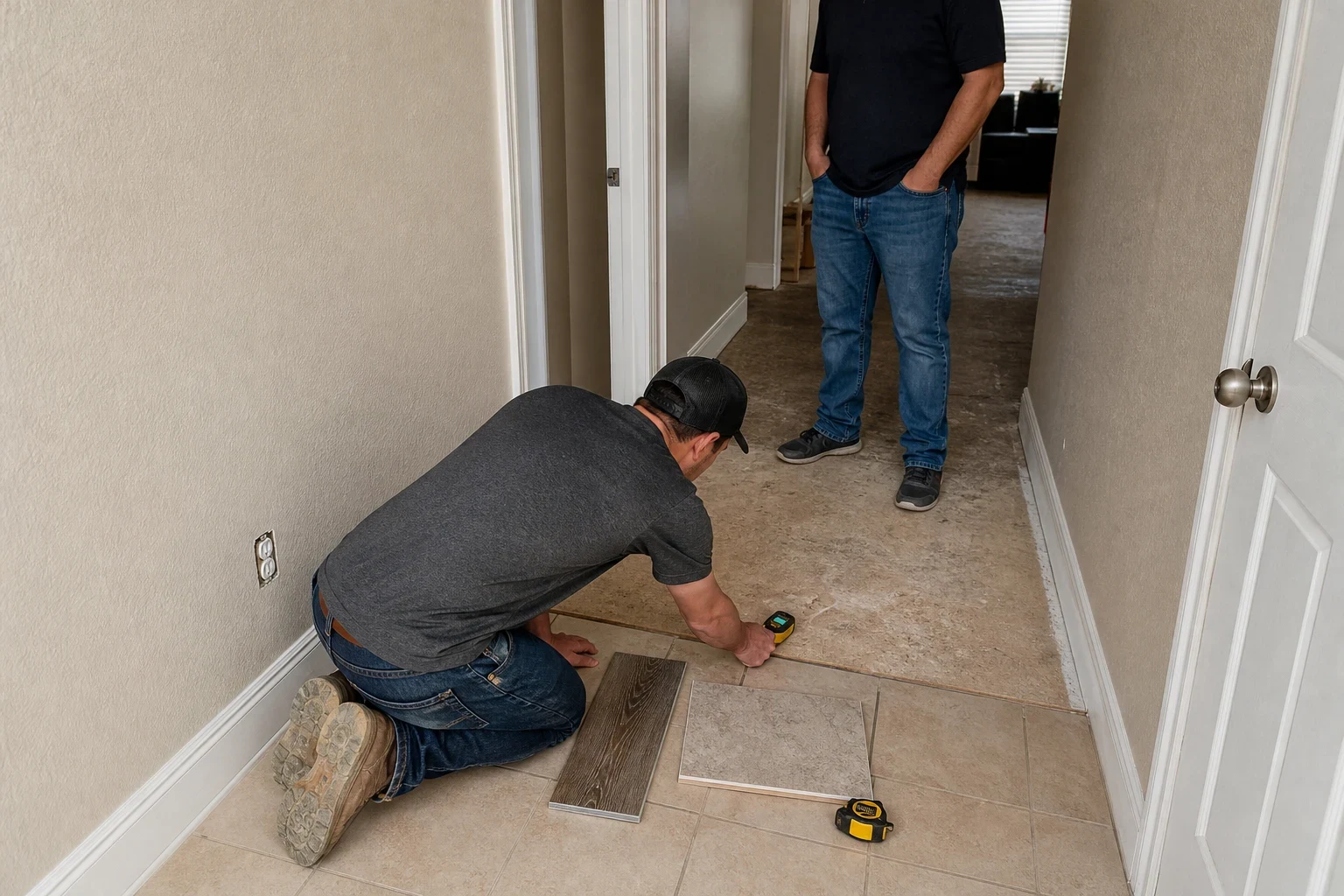
- We check the boards with a pin or pinless meter and test the slab or plywood under them. Readings tell us whether a cupped floor is still taking on water or has stabilized, which decides if a fix will hold.
- Cutting out and weaving in boards
- Damaged prefinished boards are cut out and new ones are woven into the existing pattern so end joints stay staggered. We match species, width and color from the same product line whenever it is still available.
- Loose and squeaking boards
- Squeaks usually come from boards rubbing on a loose nail or from a gap between subfloor and joist. On wood subfloors we re-fasten from below where there is access, or use trim-head screws from above and fill the heads.
- Engineered hardwood over concrete
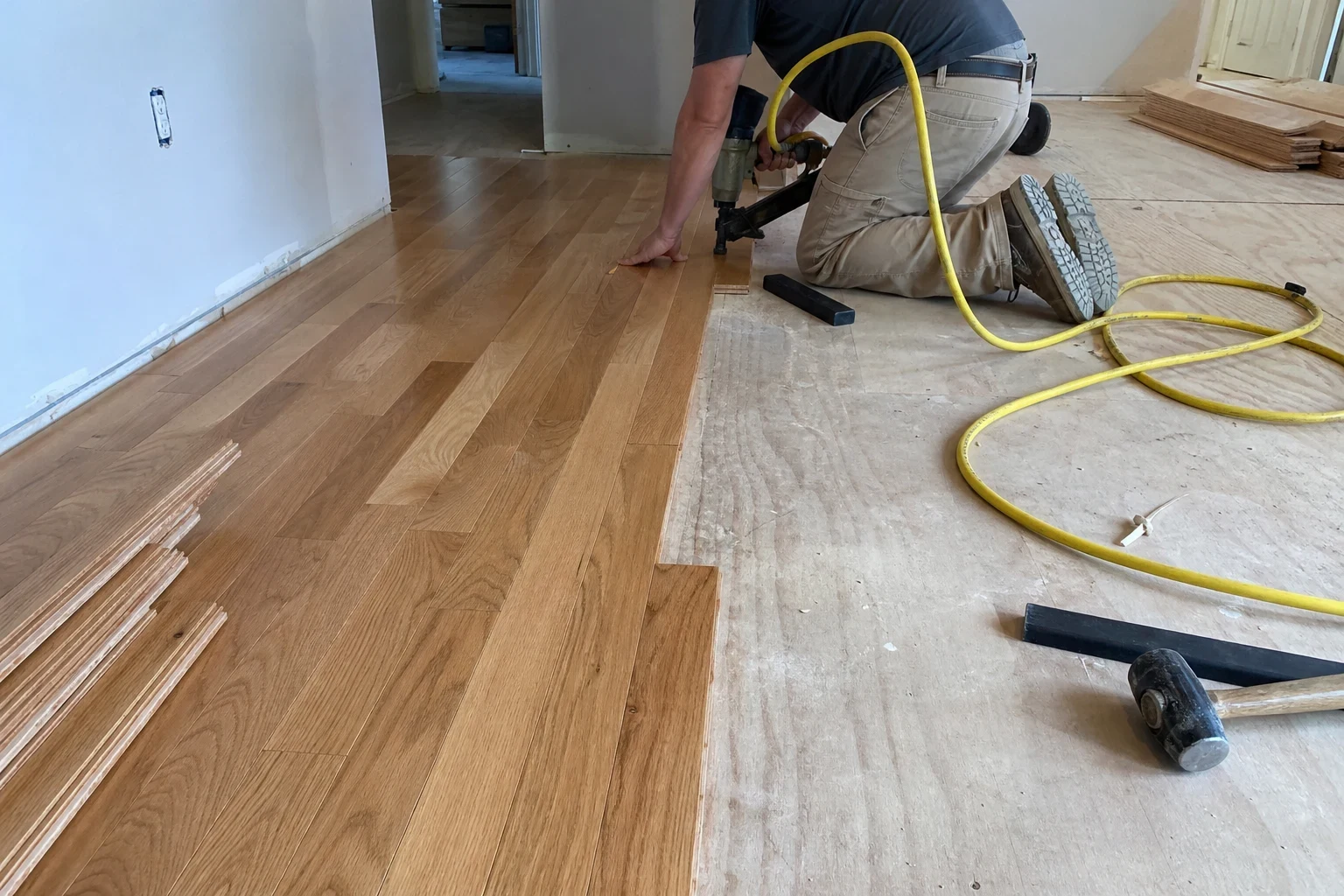
- Most single-story homes here sit on slab, so engineered hardwood is the usual choice. We glue it down with a moisture-control adhesive or float it over a vapor retarder, depending on the slab readings and the product's install rules.
- Solid hardwood on plywood subfloors
- Upstairs rooms and raised floors can take solid boards nailed over plywood with an underlayment paper. We set the required expansion gap at every wall and doorway so seasonal swelling has somewhere to go.
- Trim, transitions and cleanup
- We pull and reset baseboard or shoe molding, fit transitions to tile or carpet, and haul away cut-offs and old flooring when we leave.
Signs your hardwood needs attention
Cupped boards
Edges sit higher than the centers. The bottom of the board is wetter than the top, usually from slab moisture or a hidden leak.
Crowned boards
The center is higher than the edges. This often follows cupping that dried out unevenly and tells us the moisture source needs checking first.
Gaps that keep widening
Small seasonal gaps in dry winter months are normal. Gaps that grow year after year point to failed fasteners, adhesive breakdown or boards installed too wet.
Hollow or soft spots
A drummy sound on glued engineered flooring means the adhesive has let go. A soft spot underfoot can mean damaged subfloor, which we open up and inspect.
Dark stains near water
Gray or black areas around a sink, refrigerator line or exterior door usually mean water got into the wood fibers. Those boards need to come out, and the subfloor beneath needs to be checked.
What moves the cost of hardwood work
A repair of a few boards and a whole-room installation are priced very differently, so the first question is always scope. After that, the product you choose and what we find under the old floor make the biggest difference. Your written estimate lists each of these as its own line.
Patch scope versus a full new floor
A woven repair is mostly labor and a small amount of matched material. A new floor adds removal, disposal and full material cost.
Product choice
Solid versus engineered, species, plank width and wear layer thickness all change the material price. Wider planks and thicker wear layers cost more per square foot.
Slab and subfloor condition
High slab moisture may call for a moisture-control adhesive or vapor retarder. Uneven concrete needs grinding or patching, and rotted plywood has to be cut out and swapped for new sheets.
Removal of existing flooring
Pulling glued hardwood or tile takes longer than lifting carpet. Scraping old adhesive off a slab is often the slowest part of the job.
Layout and transitions
Hallways, closets, angled walls and many doorways add cuts and time. Stair flooring is priced separately because each tread and riser is fitted by hand.
How a hardwood job runs
- 1
Inspection and readings
We look at the damaged area, measure the room, take moisture readings and photograph what we find. If a board needs to come up to see the subfloor, we ask first.
- 2
A written plan with options
You get a written line-item estimate that explains the cause, the scope and the materials. If fixing a section and laying a new floor are both reasonable, we lay out each one so you can compare.
- 3
Prep and protection
We remove trim, cover doorways and vents, and correct the subfloor, whether that is leveling a slab high spot or swapping out a section of soft plywood. New boards acclimate in your home ahead of installation.
- 4
Installation or board work
Boards are fastened, glued or floated to the manufacturer's method, with expansion gaps kept at the perimeter. Woven patches are fitted row by row so they read as part of the original floor.
- 5
Walkthrough and cleanup
We reinstall trim, vacuum the work area and walk the floor with you. We point out any care details, such as how long to wait before setting heavy furniture on glued flooring.
Hardwood flooring questions
Can you match my existing hardwood for a repair?
Often, yes. We identify the species, width and finish, then look for the same product or a close match. If the floor is discontinued, we sometimes borrow boards from inside a closet and put the new boards there instead. If no acceptable match exists, we tell you before any work starts.
Can real hardwood go over a concrete slab?
Engineered hardwood can, glued down or floated, as long as slab moisture is within the product's limits. Solid hardwood is not a good fit directly on slab because it swells and cups with the moisture coming through the concrete. We test the slab first and recommend the method that suits the readings.
My floor cupped after a leak. Does it all have to come out?
Not always. Once the leak is fixed and the boards dry out, mild cupping can settle down, and only the stained or split boards may need replacing. If readings stay high for weeks or the boards have separated from the adhesive, new flooring in that area is the better call.
Does insurance cover water-damaged hardwood?
That depends on your policy and the cause of the water. We can provide photos, moisture readings and a written estimate your adjuster can review. The coverage decision belongs to your insurance company, not to us.
How long will I be out of the room?
A board repair usually takes part of a day. A new floor in a typical room runs a few days, plus acclimation time for the boards beforehand. With glue-down installs, we tell you how long to keep heavy furniture off while the adhesive cures.
Find out if your hardwood can be saved
Tell us what you are seeing, whether it is cupping, squeaks or stains. We will set a time to take readings and give you a clear call on saving the boards or starting fresh.