ServicesLaminate Flooring
Laminate Flooring Installation and Repair in League City
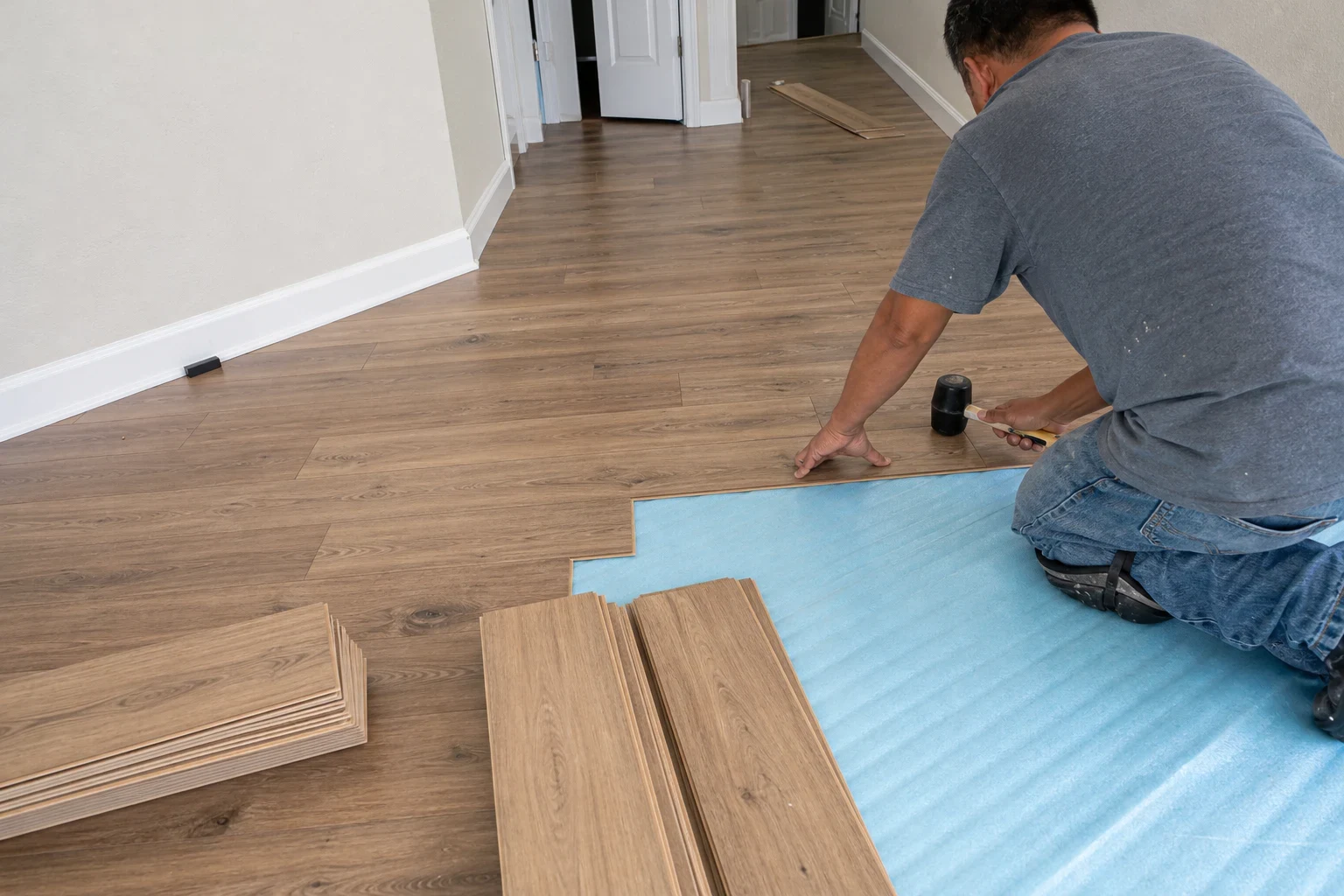
We install laminate over slab and wood subfloors, and we fix it when a few planks are the real problem. Swollen edges, a buckled run or a chipped board often trace back to one cause we can correct without pulling up the whole room. When a new floor is the better answer, we tell you why.
What laminate is, and when it is the right floor
Laminate is a layered floor: a melamine wear layer over a printed photographic film, pressed onto a high-density fiberboard (HDF) core with a balancing layer underneath. The planks click together at the edges and float over an underlayment instead of being nailed or glued down. That construction resists scratches and dents well, and it also explains the weak spot. Water that reaches the HDF core through a seam makes the fiberboard swell, and swollen fiberboard does not shrink back.
It fits living rooms, bedrooms and hallways where you want the look of wood at a lower material cost than hardwood flooring. For bathrooms and laundry rooms we usually point you toward luxury vinyl plank or tile flooring, because those cores do not absorb water.
Because the planks float, a damaged section can often come out and go back in with new boards without disturbing the rest. We check that first. If the damage is spread across the room, the product is discontinued, or the subfloor is the cause, we explain why a new floor is the better spend.
What our laminate work covers
- Plank swaps and spot repair
- We unclick planks from the nearest wall, or cut out a single damaged board and set a new one with a trimmed tongue and glue. Leftover boxes from the original install make this easiest. If you have none, we look for a match in color, thickness and locking profile.
- Buckling and gap correction
- Most buckling comes from a floor trimmed or pinned too tight against walls, cabinets or door jambs. We open the perimeter, cut back the expansion gap and reset the trim so the floor can move again.
- Subfloor prep for new installs
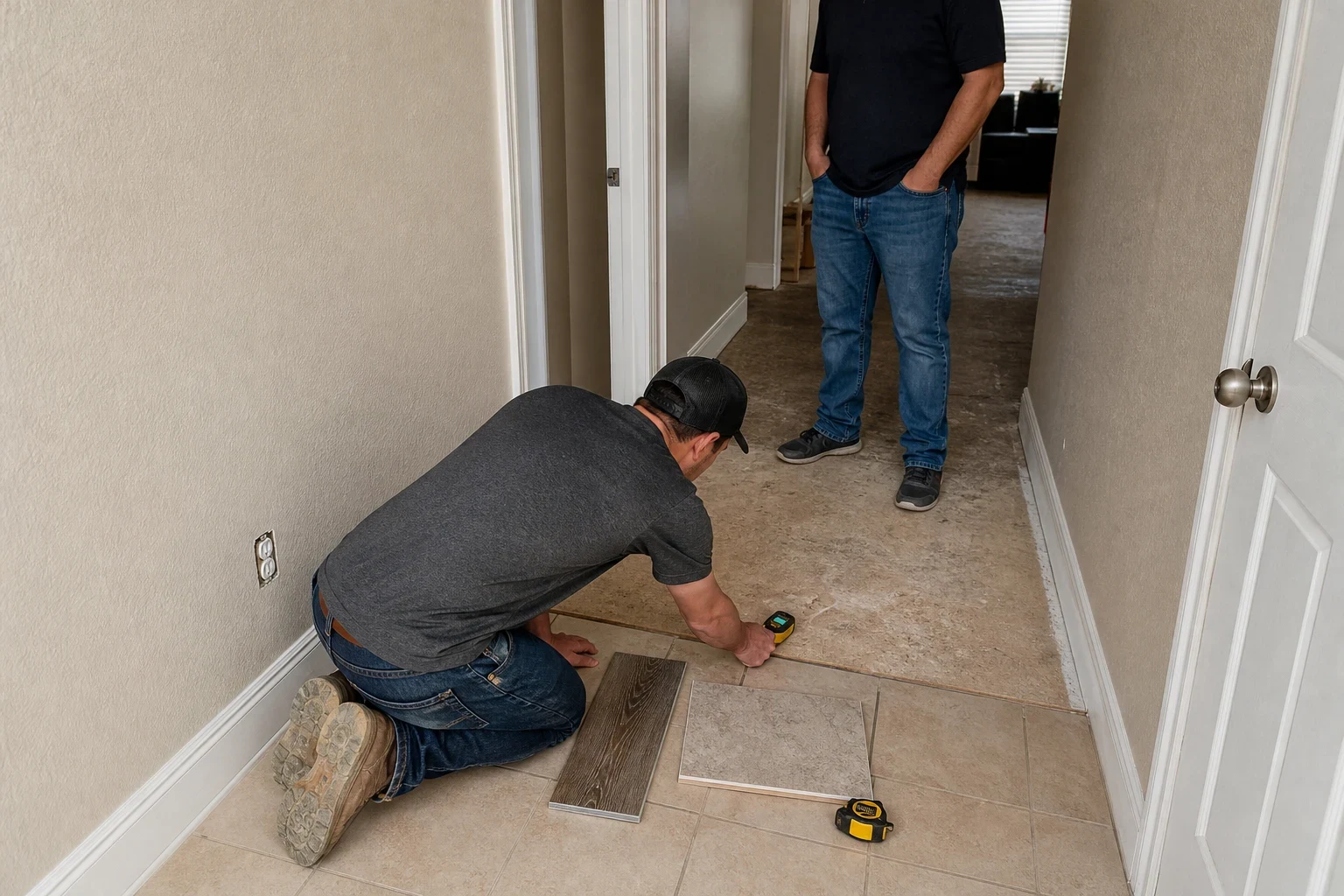
- We check slabs and wood subfloors for flatness, grind high spots and fill low ones. Manufacturers typically call for a surface flat within about 3/16 inch over 10 feet, and dips beyond that cause hollow sounds and broken locking joints.
- Moisture barrier and underlayment
- Over concrete we lay a 6-mil polyethylene vapor barrier, or an underlayment with one built in, so slab moisture does not reach the HDF core. In Gulf Coast humidity, that layer matters as much as the plank itself.
- Trim, transitions and door clearance
- We undercut door jambs so planks slide beneath them, add T-moldings where long runs or doorways need a break, and fit quarter round or baseboard over the expansion gap. If the floor continues up a staircase, our stair flooring work can carry the same plank with matching nosings.
Signs your laminate needs attention
Swollen or peaked seams
Seams that rise into small ridges mean water got into the core, often from a dishwasher, fridge line or pet accident. If it is a few planks, we swap them. If it runs across the room, the source and the extent decide whether a fix still makes sense.
Planks tenting in the middle
A floor that lifts upward mid-room is usually pinned at the edges. Freeing the perimeter often lets it lie flat again with no new material.
End joints pulling apart
Separating joints point to worn locking profiles or a subfloor that moves. We find out which before choosing between re-seating planks and swapping them out.
Hollow or clicking spots
That usually means a low spot in the slab under the planks. Left alone, the flexing at that spot snaps the locking edges.
Chips, burns or deep scratches
Once damage cuts through the wear layer into the printed film, the fix is swapping that plank.
What moves the price of laminate work
A repair and a full install are priced very differently, so the first thing we sort out is which one you actually need. After that, cost comes from the room, the product and what sits under it. You get your quote with those parts broken out.
Repair versus full replacement
Swapping a few planks is mostly labor and matching material. A full room adds tear-out, disposal, vapor barrier, underlayment and trim.
Subfloor condition
Grinding humps, leveling dips or refastening loose plywood adds time and material before the first plank goes down.
Plank thickness and wear rating
Thicker planks in the 10 to 12 mm range and higher AC ratings cost more, but they bridge minor subfloor flaws and hold up better in busy rooms.
Layout and cuts
Hallways, closets, angled walls and many doorways mean more cuts, more transitions and more waste than one open rectangle.
How a laminate job runs
- 1
Look and diagnose
We walk the floor with you, check seams, edges and the perimeter, and take a moisture reading on concrete. You hear what we think caused the problem before we talk about fixing it.
- 2
Repair-or-replace answer
We explain whether a spot fix will hold up on your floor. When it will not, you get the reason in plain terms: water spread, a discontinued product or a subfloor problem. Your quote covers the option you pick.
- 3
Acclimate and prep
New laminate sits in the room it is going into for about 48 hours so the HDF adjusts to the air in your home. We move furniture as agreed, pull old flooring and baseboards, and flatten the subfloor.
- 4
Lay the floor or fix it
We lay barrier and underlayment, stagger end joints to the manufacturer's minimum, and keep the expansion gap at every wall and fixed object. Most single rooms are finished in a day.
- 5
Trim and cleanup
Baseboards and transitions go back on, cut waste leaves with us, and we vacuum the floor. Laminate needs no cure time, so you can walk on it right away.
Laminate questions we hear
Can you replace just a few damaged planks?
Usually, yes. We either unclick back to the damaged board or cut it out and glue in a new one. Matching planks are the key, and leftover boxes from the original install are ideal. If the product is discontinued, we look for a close match or suggest a new floor in one room so the change lands at a doorway transition.
Is laminate a good choice for a kitchen?
It can work if spills get wiped up quickly and the dishwasher and fridge water lines are sound. Water sitting on a seam is what ruins it. If your kitchen sees a lot of water, we will tell you luxury vinyl plank is the safer floor there.
Can you lay laminate over my existing floor?
Over sheet vinyl or tile that is flat and firmly stuck down, often yes, as long as the added height still clears doors and appliances. We never float laminate over carpet, and anything loose or cushioned comes up first.
My floor got wet. Does all of it have to come out?
Not necessarily. Planks that swelled will not go back down, but dry planks around them are often fine. We check how far the water traveled and whether the slab and underlayment stayed wet, then replace only the damaged area when the rest is sound.
Can worn laminate be sanded down?
No. The pattern is a printed layer under a thin wear coat, so there is nothing to sand. Worn or damaged planks are swapped one at a time instead.
Find out if your laminate can be repaired
Tell us what you are seeing on the floor and we will talk through the likely cause and whether a fix or a new install fits. We work in League City and nearby towns like Friendswood, Webster and Dickinson.